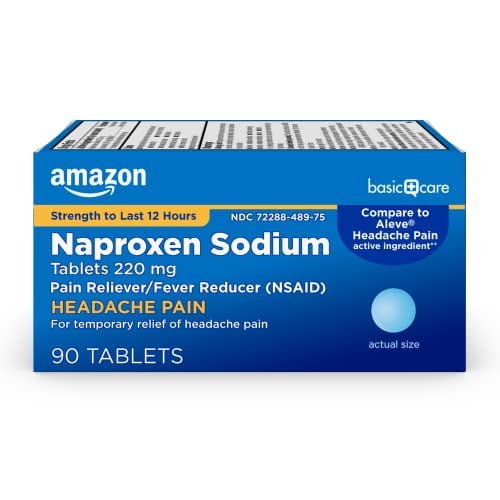
Naproxen Sodium
Of course. Here is a detailed profile for a commonly prescribed and effective medication for knee pain, focusing on its use for osteoarthritis.
### **Medicine Details: Naproxen Sodium**
**1. Generic Name:** Naproxen Sodium
**2. Common Brand Names:** Aleve (OTC), Anaprox DS, Naprosyn (prescription strength)
**3. Drug Class:** Non-Steroidal Anti-Inflammatory Drug (NSAID)
**4. Primary Use for Knee Pain:**
* **Osteoarthritis:** Reduces inflammation, pain, and stiffness in the knee joint.
* **Acute Musculoskeletal Injuries:** (e.g., sprains, strains) Used for short-term pain and inflammation relief.
* **Other Inflammatory Conditions:** Such as tendinitis or bursitis affecting the knee.
**5. Mechanism of Action:**
Naproxen works by inhibiting the enzymes **COX-1 and COX-2**, which are responsible for producing prostaglandins. Prostaglandins are chemicals that promote inflammation, pain, and fever. By reducing their levels, naproxen effectively decreases joint swelling and pain, improving mobility.
**6. Standard Dosage (for Adult Osteoarthritis):**
* **Over-the-Counter (OTC):** 220 mg tablet/caplet. Take one every 8-12 hours as needed. Do not exceed 3 tablets (660 mg) in 24 hours.
* **Prescription Strength:** Typical dose is 250 mg, 375 mg, or 500 mg twice daily. **Always follow your doctor's specific prescription.**
* **Key Instruction:** Take with a full glass of water and with food or milk to minimize stomach upset.
**7. Onset of Action & Duration:**
* **Onset of Pain Relief:** Typically 1-2 hours.
* **Peak Effect:** 2-4 hours.
* **Duration:** Provides relief for 8-12 hours, making it a "longer-acting" NSAID.
**8. Common Side Effects:**
* Heartburn, stomach pain, nausea
* Dizziness, headache
* Mild fluid retention
**9. Important Warnings & Contraindications:**
* **Cardiovascular Risk:** May increase the risk of heart attack or stroke, especially with long-term use or in people with heart disease.
* **Gastrointestinal Risk:** Can cause stomach/intestinal bleeding, ulcers, or perforation, which can be fatal. Risk is higher in the elderly.
* **Kidney Impairment:** Can reduce blood flow to the kidneys. Avoid if you have severe kidney disease.
* **Allergy:** Do not take if you have had asthma attacks, hives, or allergic reactions after taking aspirin or other NSAIDs.
* **Drug Interactions:** Do not combine with other NSAIDs (e.g., ibuprofen, aspirin). Interacts with blood thinners (warfarin), SSRIs (e.g., sertraline), and certain blood pressure medications. **Always inform your doctor/pharmacist of all medications you take.**
**10. Special Considerations:**
* **Use the lowest effective dose for the shortest possible duration.**
* Not recommended during the third trimester of pregnancy.
* More suitable for **chronic, inflammatory pain** (like osteoarthritis) rather than immediate, short-term pain relief due to its longer onset time.
**11. Non-Pharmacological & Adjunctive Advice:**
* For best results in managing knee osteoarthritis, combine medication with:
* **Weight Management**
* **Physical Therapy** and targeted exercises (e.g., quadriceps strengthening)
* **Low-Impact Activity** (swimming, cycling)
* **RICE Protocol** for acute injuries (Rest, Ice, Compression, Elevation)
---
**Disclaimer: This information is for educational purposes only and does not constitute medical advice. Always consult with a healthcare professional (doctor or pharmacist) before starting any new medication to ensure it is appropriate and safe for your specific health situation.**
Product Details
How It Works
Excellent question. Let's break down **exactly how naproxen sodium (and other NSAIDs like ibuprofen) works to relieve knee pain**, going deeper into the mechanism mentioned earlier.
The key is understanding a process called **inflammation**.
### **The Core Problem: Inflammation & Prostaglandins**
When your knee is injured (like a sprain) or affected by a disease like osteoarthritis, your body's immune system launches an **inflammatory response**. This involves sending extra blood and immune cells to the area, which causes:
* **Swelling (Heat & Redness)**
* **Pain**
* **Stiffness**
A family of chemicals called **prostaglandins** are the primary messengers that *orchestrate* this painful process. They are made on-demand at the site of injury.
### **The Enzyme Factory: COX-1 and COX-2**
Your body produces prostaglandins using special enzymes named **Cyclooxygenase**, or **COX** for short. There are two main types relevant to pain:
1. **COX-1:** The "housekeeping" enzyme. It's always active, making prostaglandins that protect your stomach lining, support kidney function, and help with blood clotting.
2. **COX-2:** The "inducible" or "inflammatory" enzyme. Its production surges at sites of injury or damage (like an arthritic knee). **COX-2 is primarily responsible for making the prostaglandins that cause pain, fever, and inflammation.**
### **How Naproxen Intervenes: The Enzyme Blocker**
**Naproxen is a COX inhibitor.** Its chemical structure allows it to fit into the active site of *both* COX-1 and COX-2 enzymes, like a key jamming a lock.
* By **binding to and blocking the COX-2 enzyme**, naproxen dramatically **reduces the production of "bad" prostaglandins** at the source of your knee pain.
* **Result:** Less inflammation, less swelling, less pain signaling to your brain, and reduced fever.
### **Visual Analogy: A Fire Alarm System**
Think of your injured knee as a building where a small fire (injury/degeneration) has started.
* **Prostaglandins** are the **alarm bells, sprinklers, and firefighters** all rushing in. They're trying to help, but they also cause a lot of commotion (pain & swelling).
* **COX-2** is the **control panel** that activates all these alarms and systems.
* **Naproxen** is the person who **walks in and pulls the main fuse on the control panel (COX-2)**. The fire (injury) is still there, but the overwhelming, damaging alarm response (inflammation) is shut down, allowing for calmer repair.
### **The Trade-Off: Blocking COX-1 Explains Side Effects**
Because naproxen **also blocks COX-1** (it is a *non-selective* NSAID), it affects the "good" prostaglandins, which explains its most common side effects:
* **Stomach Upset/Ulcers:** Less COX-1 means less prostaglandin protecting your stomach lining from acid.
* **Bleeding Risk:** Less COX-1 can affect platelet function (involved in blood clotting).
* **Kidney Issues:** In vulnerable individuals, blocking prostaglandins that regulate kidney blood flow can be problematic.
**Newer NSAIDs** (like celecoxib/Celebrex) are **COX-2 selective**. They target *only* the inflammatory enzyme, aiming to reduce pain with fewer stomach side effects, but they carry their own cardiovascular considerations.
### **Summary: The Chain Reaction for Knee Pain Relief**
1. **Injury/Degeneration** in the knee (e.g., cartilage wear in osteoarthritis).
2. **COX-2 Enzyme** activity skyrockets at the injury site.
3. **Prostaglandin Production** ramps up.
4. **Prostaglandins** cause blood vessels to dilate (swelling, heat), sensitize pain nerves (pain), and attract immune cells.
5. **Naproxen enters the bloodstream**, travels to the knee, and **blocks the active site of the COX enzymes**.
6. **Prostaglandin production plummets.**
7. **The inflammatory signals decrease:** swelling goes down, pain nerves become less sensitive, and stiffness eases.
8. **Result:** Reduced knee pain and improved function, **treating the symptom (pain/inflammation) but not the underlying cause** (e.g., the worn cartilage itself).
**In essence, naproxen works by intercepting the chemical messaging system that creates the feeling of pain and inflammation in your knee, providing symptomatic relief so you can move and function more comfortably.**